Bowing Wall Stabilization Thornton CO
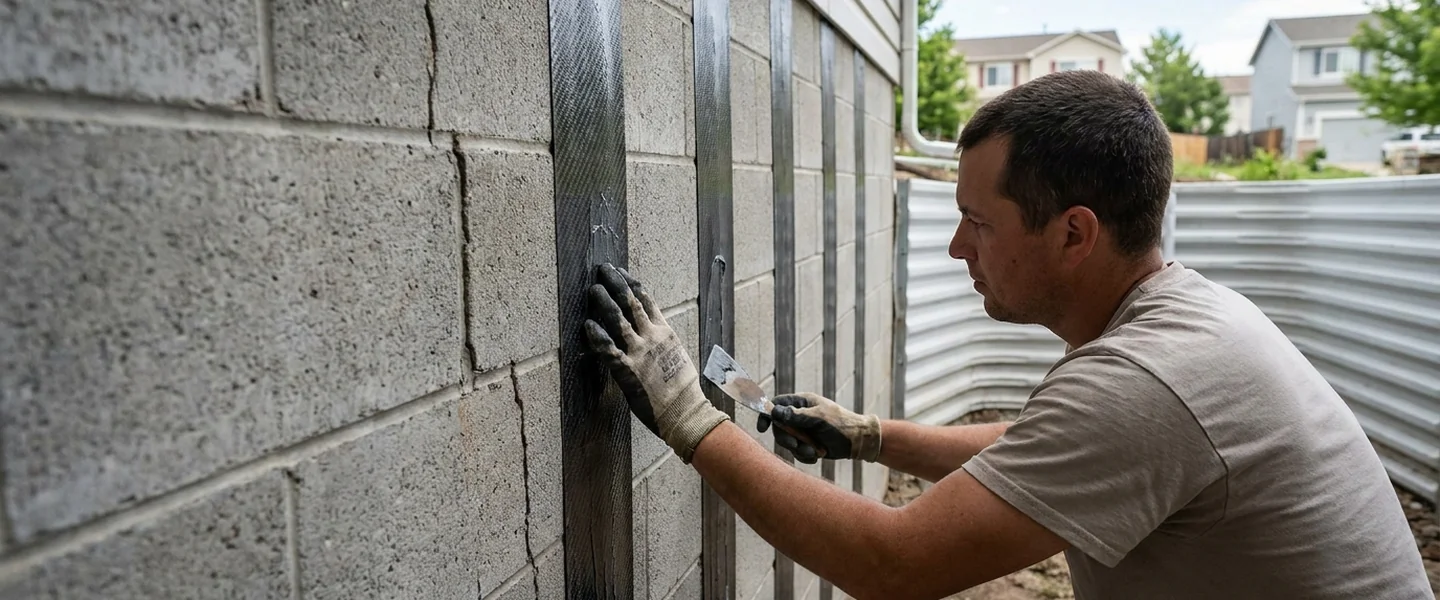
Carbon fiber straps and wall anchor systems stop inward-leaning basement walls without excavation — preserving your landscaping and driveway while permanently arresting the movement. Serving Thornton, Westminster, Northglenn, and Adams County.
Call (720) 740-6511 — Free InspectionA bowing basement wall is one of the more urgent foundation issues a Thornton homeowner can face. When expansive clay soil pushes inward against an older block or concrete wall, the wall doesn't crack — it bows. The movement is slow at first, then accelerates as the wall loses its capacity to resist. Left unaddressed, bowing walls eventually fail completely, and at that point the repair cost multiplies several times over. Carbon fiber straps halt the movement immediately and add tensile strength that the original wall never had.
We install two systems depending on wall condition and soil access: carbon fiber straps for walls with 2 inches of inward deflection or less, and wall anchors (helical tieback anchors set into stable soil away from the wall) for walls with more than 2 inches of bow or where additional recovery is needed. Both systems can be installed from inside the basement — no excavation.
Bowing Walls on Colorado's Front Range
The classic bowing wall scenario in Adams County: a 1965–1975 concrete block home in Westminster or Northglenn, with the original poorly-draining clay backfill against the block wall, and downspouts that terminate 2 feet from the foundation. Every spring snowmelt cycle saturates that clay, adds hundreds of pounds of hydrostatic and lateral pressure, and the block wall's horizontal mortar joints become the hinge points of inward movement. By the time a homeowner notices a horizontal crack at the midpoint of the wall, the bow may already be 1–1.5 inches.
Broomfield townhomes and newer Brighton subdivisions on compacted fill show a different variant: walls that bow early (within 10–15 years of construction) because the fill soil was never fully compacted and settles unevenly, creating localized pressure points. These walls often bow over a shorter section rather than the full length.
Project Details
| Timeline | Inspection + written quote: 1 day. Carbon fiber install: 1 day. Wall anchor install: 1–2 days depending on anchor count. |
|---|---|
| Carbon Fiber System | Fortress Stabilization Systems carbon fiber straps or equivalent — 200,000 psi tensile strength, bonded with structural epoxy. Strap every 4–6 feet along the bowing section. |
| Wall Anchor System | Helical tieback anchors driven at angle through the wall into stable native soil; bearing plate set on interior wall face. Anchors can be tensioned over time to gradually restore wall plumb. |
| Warranty | Lifetime transferable warranty on carbon fiber straps. 25-year transferable warranty on wall anchor hardware and installation. |
| Excavation Required | No exterior excavation for either system. Both installed entirely from inside the basement. |
| Pricing | Quoted per job after free on-site inspection — itemized by system type, strap/anchor count, and linear footage. |
Our Wall Stabilization Process
- 1Deflection Measurement — We measure wall bow at multiple points using a 4-foot level and digital inclinometer. Deflection under 2 inches qualifies for carbon fiber. Over 2 inches, we recommend wall anchors and discuss recovery options (gradual re-tensioning over 18–24 months).
- 2Wall Preparation — For carbon fiber: the wall face is ground smooth and any efflorescence or loose material removed. For wall anchors: a coring drill cuts a 3-inch hole through the wall at each anchor location.
- 3Strap or Anchor Installation — Carbon fiber straps are bonded with two-part structural epoxy and anchored at the floor and rim joist. Wall anchors are driven to target torque in native soil and the bearing plate set flush with the wall face.
- 4Top-Plate Connection — Each carbon fiber strap is attached to the rim joist or top plate with a heavy steel bracket, transferring the load to the floor structure above rather than relying solely on the epoxy bond.
- 5Crack Injection (if needed) — Horizontal cracks present in the bowing section are injected with polyurethane or epoxy after strap installation to seal against water entry. We include this in the scope if cracks are active.
- 6Documentation & Baseline Measurement — Post-install deflection is recorded and placed in your warranty file. This baseline is what we measure against at the 12-month recheck to confirm zero additional movement.
Common Bowing Wall Scenarios in Thornton
Mid-Wall Horizontal Crack
The most common presentation in Northglenn and Westminster block walls — a clean horizontal crack at 4–5 feet below grade where lateral soil pressure peaks. The wall above the crack is already bowing inward. Carbon fiber straps bridging the crack and running floor-to-ceiling stop further movement immediately.
Corner Bowing
Less common but structurally more complex — the wall bows at a corner where two walls meet. Corner zones have less structural support from adjacent walls. We may recommend anchors on both affected walls plus crack injection at the corner joint.
Full-Length Wall Deflection
When the entire length of a long basement wall bows uniformly, the soil loading is distributed — often from a combination of poor drainage and root intrusion from mature trees near the foundation. Wall anchors on 6-foot centers with gradual re-tensioning are the preferred recovery method.
Broomfield Fill-Soil Bowing
Newer homes on engineered fill in Broomfield can show localized bowing even in poured concrete walls when fill settles unevenly. These sections require coring for anchors rather than carbon fiber, because the localized pressure zone is too small for the strap system to address efficiently.
Warranty in Detail
Carbon fiber straps: Lifetime transferable warranty on the strap material and epoxy bond. Carbon fiber does not corrode, fatigue, or lose tensile strength over time — the material warranty is as close to unconditional as any building product gets.
Wall anchors: 25-year transferable warranty on hardware and installation workmanship. Anchor heads are accessible for re-tensioning; if any future movement is detected at the 12-month or subsequent inspection visits, we re-tension at no charge within the warranty period.
What the warranty does NOT cover: new movement caused by major drainage failures not present at install time, excavation or grading changes within 10 feet of the wall after installation, or freeze-thaw events that displace the anchor's bearing plate (rare in Colorado's relatively dry subsoil at anchor depth).
Transfer: Both warranties transfer to the next owner automatically. The deflection baseline measurement at install and the 12-month follow-up measurement give future owners documented proof of zero additional movement — a genuine value in the Adams County real estate market.
After the Stabilization Install
30 days: We ask you to observe the strap surface for any peeling, bubbling, or epoxy failure — these are rare but we want to know immediately. Wall anchor bearing plates should be checked for any loosening (you can do this yourself by hand).
12 months: We return to remeasure deflection at the original measurement points and compare against the baseline. Any movement detected triggers a warranty review and re-tensioning or supplemental anchor if needed. We issue a written one-year clearance for your warranty file.
Wall anchor re-tensioning: For wall anchor systems used for recovery (not just arrest), re-tensioning is typically done at 6-month intervals for 18–24 months to gradually push the wall back toward plumb. This is a 30-minute service call each time, included in the anchor warranty.
Bowing Wall Stabilization FAQ — Thornton, CO
How do I know if my wall is bowing?
Hold a 4-foot level flat against the wall at waist height. Any gap between the level and the wall indicates inward deflection. A horizontal crack at mid-wall height is a strong visual indicator. If you see either, call (720) 740-6511 — we'll measure it precisely at the free inspection.
Can a bowing wall be straightened back to plumb?
Partially, with wall anchors and gradual re-tensioning over 18–24 months. Carbon fiber straps arrest movement but don't restore plumb. Full recovery to original position is rarely possible without exterior excavation. We'll tell you realistically what each system achieves before you commit.
How urgent is a bowing wall?
More urgent than most homeowners assume. Lateral wall movement is typically slow for years, then accelerates as the wall loses structural capacity. Once a wall has bowed more than 4 inches, the repair options become significantly more expensive and invasive. We recommend acting at the first sign of horizontal cracking or visible bow.
Will you need to excavate outside my foundation?
No — both carbon fiber straps and wall anchors are installed entirely from inside the basement. Your landscaping, driveway, and exterior flatwork are untouched. This is the primary advantage of these systems over traditional exterior excavation and wall replacement.
How long does the carbon fiber strap installation take?
Most installs complete in one day. A 30-foot bowing section with 6 straps typically takes 6–8 hours. We'll give you a specific estimate in the written quote after measuring the wall.
Can I finish the basement after carbon fiber strap installation?
Yes. The straps can be covered with stud walls and drywall. We recommend a 1-inch clearance between the drywall and the strap face so the straps are accessible for future inspection. We'll note the strap locations in your warranty documentation.
Does homeowners insurance cover bowing walls?
Standard policies exclude gradual structural movement. Sudden events (earthquake, water main break undermining the soil) may be covered. We document the inspection findings for any claim you want to file, but call your carrier before the inspection to understand your policy.
Do I need both bowing wall repair and waterproofing?
Often, yes — the hydrostatic pressure that bows walls also forces water through the resulting cracks. We typically address wall stabilization first (to stop the movement), then crack injection and waterproofing to seal the system. We quote both in a single inspection so you see the complete picture.
Stop the Wall Before It Gets Worse
A bowing wall doesn't fix itself — it accelerates. Same-week inspections available in Thornton, Westminster, Northglenn, and Brighton.
Call (720) 740-6511Related Services
What You Get in Our Quote vs. the Lowball Bid
We don't compete on the lowest sticker price — we compete on the quote that gets the job actually done. Here is what is included in every quote we write, and the cut-corners that show up in cheaper bids.
Included in our written quote
- Engineer-style elevation + crack assessment
- Soil and drainage evaluation
- Written quote with pier counts + warranty terms
- Photo documentation of every crack/movement
- Permit-pulling where required
- Post-install elevation re-check
Cut corners in the lowball bid
- Free-quote with no actual inspection
- Pier-count guesses without measurements
- Subcontracted installation crews
- Warranties that exclude common failure modes
- Pressure to sign at the kitchen table
- Same-day pricing tricks