Foundation Crack Repair Thornton CO
Polyurethane and epoxy injection sealing for active and dormant foundation cracks — flexible for water-active cracks, rigid for structural ones. Serving Thornton, Northglenn, Westminster, and Adams County.
Call (720) 740-6511 — Free InspectionA crack in a Thornton foundation wall isn't always a crisis — but it's never cosmetic. Colorado's bentonite clay swells and shrinks with every wet and dry cycle, placing cyclic stress on concrete and block walls that eventually shows up as cracks. The question isn't whether to address a crack, but which material to inject and whether the crack is structural or just a sealing issue. We make that determination on-site before we quote anything.
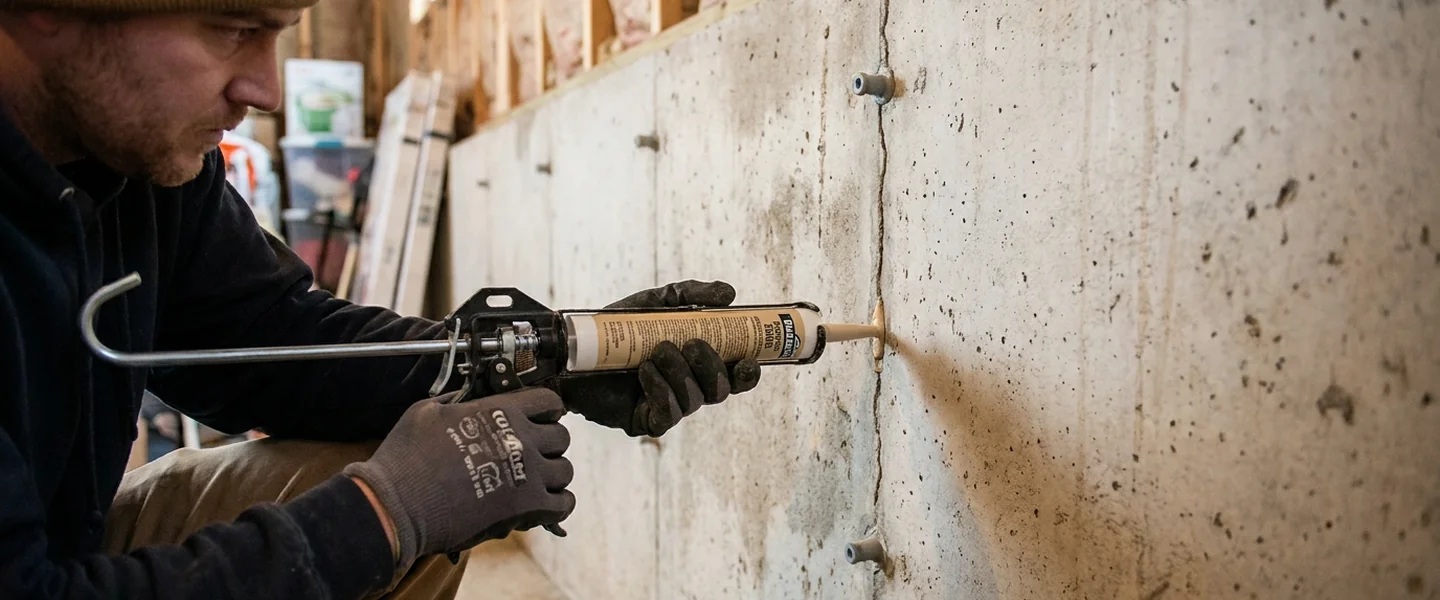
We use two injection materials depending on what the crack is doing: polyurethane foam for active water-leaking cracks (it expands to fill the void and bonds to wet concrete), and two-part epoxy for dormant structural cracks that need rigid reinforcement. The wrong choice makes the problem worse — epoxy in an active crack just gets pushed out by the water pressure; polyurethane in a structural crack doesn't restore load capacity.
Foundation Cracks on Colorado's Front Range
Adams County soil contains a significant percentage of expansive clay minerals — predominantly montmorillonite. In a typical Thornton year, the top four feet of soil cycles through significant moisture content changes between winter, spring snowmelt, and summer heat. That soil movement imposes horizontal and diagonal stress on foundation walls that weren't designed for soil pressure to vary this dramatically season to season.
The most common crack patterns we see: vertical cracks from concrete shrinkage or differential settlement, horizontal cracks from lateral soil pressure (most common in Westminster and Northglenn block walls), and stair-step cracks in mortar joints of older brick and block construction. Diagonal cracks — especially ones wider at the top — typically indicate settlement and warrant a piering evaluation in addition to crack repair.
Brighton and Commerce City homes on compacted fill soils from 1990s–2000s construction sometimes show a different pattern: multiple narrow shrinkage cracks in a poured concrete wall, often appearing within 5–10 years of construction as the fill consolidates. These are usually sealing candidates rather than structural concerns, but we confirm with a level measurement across the wall before making that call.
Project Details
| Timeline | Inspection + written quote: 1 day. Most crack repairs complete in 2–4 hours per crack. Multi-crack jobs typically done in one day. |
|---|---|
| Materials | Polyurethane foam (Sika Injection-201 or equivalent) for active cracks; two-part structural epoxy (Simpson SET-XP or equivalent) for dormant structural cracks. |
| Warranty | 10-year transferable workmanship warranty on each injected crack zone. If the same crack re-opens or re-leaks, we return and reinject at no charge. |
| Permit Required | No permit required for crack injection in Adams County. Structural repairs requiring pier installation may require a permit — we handle that. |
| Disruption | Minimal. Interior injection means no excavation, no landscaping damage. Most residents remain in the home during the repair. |
| Pricing | Quoted per job after free on-site inspection — every quote is itemized in writing by crack count and material type. |
Our Crack Repair Process
- 1Crack Classification — We measure crack width, length, and orientation. We check for displacement (one side higher than the other), active leaking, and evidence of ongoing movement with a tell-tale crack monitor applied during the inspection. This determines injection material and whether structural repair is also needed.
- 2Port Installation — Injection ports are surface-mounted or drilled at 6–8-inch intervals along the crack, staggered from both faces of the wall when accessible. Port spacing is tighter for narrower cracks and for sections showing active moisture.
- 3Surface Seal — Crack faces between ports are sealed with epoxy paste to contain injection pressure and prevent the material from escaping through the wall face before it fills the void depth.
- 4Low-Pressure Injection — Material is injected at low pressure (not high pressure, which can cause spalling) starting at the lowest port and working upward. We inject until material appears at the next-higher port, then cap and move up. This ensures void fill from the bottom of the crack upward.
- 5Cure Time & Port Removal — Polyurethane cures in 15–30 minutes; epoxy requires 24 hours. Ports and surface paste are removed after cure. The injection zone is ground flush where appearance matters.
- 6Written Documentation — We photograph each crack before and after, document the material used and port locations, and add the repair to your warranty file. This matters for resale disclosures and follow-up inspection.
Common Crack Scenarios in Adams County
Vertical Shrinkage Cracks
Appear in the first 5–10 years of a poured concrete wall as the concrete cures and the clay around it begins its expansion cycle. Typically thin (under 1/16") and non-structural. Polyurethane injection seals them against water entry. We monitor for widening before clearing them as non-structural.
Horizontal Cracks (Lateral Pressure)
The most serious crack type. Horizontal cracks at or just below grade level — especially in Westminster and Northglenn block walls — indicate the soil is pushing the wall inward. Crack injection seals the leak, but bowing wall stabilization is required to stop the movement. We flag these in the inspection report and include both in the quote.
Stair-Step Mortar Joint Cracks
Classic in Thornton's older brick and block foundations. The mortar joint — not the block itself — follows the path of least resistance when differential settlement occurs. These require tuckpointing (repointing the mortar) plus structural epoxy injection at key diagonal sections. May also indicate piering is needed if settlement is ongoing.
Diagonal Corner Cracks
Diagonal cracks radiating from corners at 45 degrees are the signature of differential settlement — one corner of the foundation is moving down while another holds. We place a crack monitor at the inspection visit and check it before committing to injection alone vs. injection plus piering. Getting this classification wrong costs money.
Warranty in Detail
Our crack repair warranty covers the specific injected crack zone for 10 years, fully transferable. If the crack re-opens or re-leaks within 10 years at the injected zone, we return and reinject at no charge, no questions.
What the warranty covers: re-opening or re-leaking of an injected crack through the same zone. Polyurethane seal failure. Epoxy delamination from the concrete substrate (rare with proper surface preparation).
What the warranty does NOT cover: new cracks that form outside the repaired zone, structural movement that wasn't present at the time of repair (e.g., new settlement events), damage caused by improper drainage or hydrostatic pressure that wasn't addressed as part of the scope.
Transfer: Warranty transfers automatically to any subsequent owner. We provide a repair record with before/after photos, material specs, and warranty terms — include it in your disclosure package at closing.
How We Quote (Without Quoting on the Phone)
Crack repair pricing depends on the number of cracks, their length and width, whether they're active or dormant, and whether structural work is also needed. A call telling us "I have one crack, about 3 feet long" doesn't tell us the crack width, the orientation, whether it's displaced, or whether the soil around that section is saturated. We need to see it. The free inspection takes 45 minutes; the written quote follows the same day.
After the Crack Repair
30 days: We follow up to confirm no re-seeping through the repaired zone. If you had the repair done in a dry period, we may ask you to check after the first significant rain event and report back.
12 months: We return for a follow-up inspection included in the warranty — we check crack width with a feeler gauge, look for any new cracks in the repaired zone, and confirm the injection material is fully cured and bonded. Most injected cracks require no follow-up treatment; we document the one-year check in your warranty record.
Foundation Crack Repair FAQ — Thornton, CO
Are foundation cracks normal in Colorado houses?
Hairline shrinkage cracks are common in concrete walls — they don't necessarily indicate structural failure. What matters is the crack's orientation, width, and whether it's growing. Horizontal cracks and diagonal cracks wider than 1/4 inch in Colorado clay environments need professional evaluation. Call (720) 740-6511 and we'll come look at it.
How do I know if my crack is structural or just a sealing issue?
Horizontal cracks are almost always structural — they indicate lateral soil pressure. Diagonal cracks from corners suggest settlement. Vertical cracks are usually shrinkage or sealing issues. But width, displacement, and growth rate matter too. We make this determination at the inspection before committing to a repair method.
Can you repair cracks from inside the basement?
Yes — that's the standard approach for most residential cracks. Interior low-pressure injection fills the void through the full depth of the wall without exterior excavation. Exterior crack repair requires digging out the wall and is only warranted for very severe cases or when exterior waterproofing is also being installed.
How long does crack injection take?
Most crack repairs complete in 2–4 hours per crack, depending on length and void depth. A home with 3–4 cracks typically finishes in a single day. We'll give you a specific time estimate in the written quote after seeing the cracks.
Will repair affect my home's resale value?
A professionally repaired and documented foundation crack is better than an undisclosed one at resale. Buyers in the Adams County market order foundation inspections — a repair with a warranty card and before/after documentation in your disclosure is a stronger position than "we didn't know about it."
What's the difference between epoxy and polyurethane injection?
Polyurethane foam expands to fill irregular voids and bonds to wet surfaces — used for active water-leaking cracks. Epoxy is rigid and restores tensile strength — used for dormant structural cracks that need structural reinforcement. We choose the material based on the crack's condition at the time of inspection.
Does homeowners insurance cover foundation crack repair?
Standard homeowners policies typically exclude gradual settlement and soil movement — which covers most foundation cracking. Sudden events (earthquake, frost heave from a plumbing leak) may be covered. We can document the inspection findings to support a claim, but call your carrier first to understand your specific policy.
How long until I need to repair again after injection?
Properly injected cracks in stable walls don't reopen. The failure mode to watch for is a new crack forming adjacent to the repaired zone — that indicates ongoing settlement. Our 12-month inspection visit documents crack width in the repaired zone and flags any new crack formation so you can decide about piering before the settlement progresses.
Not Sure If That Crack Is Serious?
Let us look at it. Free on-site inspection, written report same day. Same-week appointments in Thornton, Westminster, and Northglenn.
Call (720) 740-6511Related Services
Service Areas
What You Get in Our Quote vs. the Lowball Bid
We don't compete on the lowest sticker price — we compete on the quote that gets the job actually done. Here is what is included in every quote we write, and the cut-corners that show up in cheaper bids.
Included in our written quote
- Engineer-style elevation + crack assessment
- Soil and drainage evaluation
- Written quote with pier counts + warranty terms
- Photo documentation of every crack/movement
- Permit-pulling where required
- Post-install elevation re-check
Cut corners in the lowball bid
- Free-quote with no actual inspection
- Pier-count guesses without measurements
- Subcontracted installation crews
- Warranties that exclude common failure modes
- Pressure to sign at the kitchen table
- Same-day pricing tricks