House Leveling & Piering Thornton CO
Steel push piers and helical piers driven past Colorado's unstable clay to load-bearing bedrock — permanently stabilizing and optionally lifting settled foundations. Serving Thornton, Brighton, Commerce City, and Adams County.
Call (720) 740-6511 — Free InspectionWhen a foundation settles, the soil underneath it has compressed, washed out, or shrunk away — and no surface-level fix addresses that root cause. Piering is the only permanent solution: steel piers driven or screwed past the unstable clay layer to competent bedrock or dense load-bearing strata, then used to transfer the building's weight off the failing soil and onto solid ground. Done correctly, a piered foundation can be lifted back toward its original elevation and won't settle again.
We install two pier systems: steel push piers (driven hydraulically to refusal against bedrock — the standard for Thornton and Adams County where bedrock is 15–40 feet down) and helical piers (screwed in mechanically — better for low-load structures, new construction, and sites where the soil profile doesn't support push pier refusal). We determine which system is right for your soil and structure at the on-site inspection.
Why Thornton Homes Settle — And Why Piering Fixes It Permanently
Adams County sits on a thick layer of expansive bentonite clay that shrinks dramatically in dry summers and expands in wet springs. A foundation built on this clay is essentially floating on a material that changes volume by inches every year. Over decades, this cycling compresses some soil zones while leaving others relatively stable, creating differential settlement — one corner drops while another holds. The result is the sticking doors, diagonal wall cracks, and sloping floors that Thornton homeowners recognize.
Commerce City homes on industrial fill from the 1950s and 1960s, Brighton homes on alluvial river deposits near the South Platte, and Northglenn homes on the original prairie clay all show settlement for soil-specific reasons — but the fix is the same: bypass the failing layer with steel piers anchored to something that doesn't move. Colorado's bedrock profile in Adams County allows push piers to reach refusal at reasonable depths, making this one of the most cost-effective piering markets in the Mountain West.
Project Details
| Timeline | Inspection + written quote: 1 day. Pier installation: 1–3 days depending on pier count and access. |
|---|---|
| Push Pier System | Steel tube piers (2.875" or 3.5" OD), driven hydraulically to refusal, attached to foundation bracket. Lift applied via synchronized hydraulic jacks. |
| Helical Pier System | Galvanized helical shaft with one or two helix plates, driven by hydraulic torque motor to target torque (correlates to load capacity). Used for porches, additions, and low-load applications. |
| Warranty | Lifetime transferable warranty on push pier hardware and installation. 25-year transferable warranty on helical pier installation. |
| Lift Potential | Most settled Thornton foundations can be lifted 1–3 inches toward original elevation during pier installation. Full recovery to original grade is rare; we document realistic lift expectations in the written quote. |
| Pricing | Quoted per job after free on-site inspection — itemized by pier type, count, depth estimate, and lift scope. |
Our Piering Process
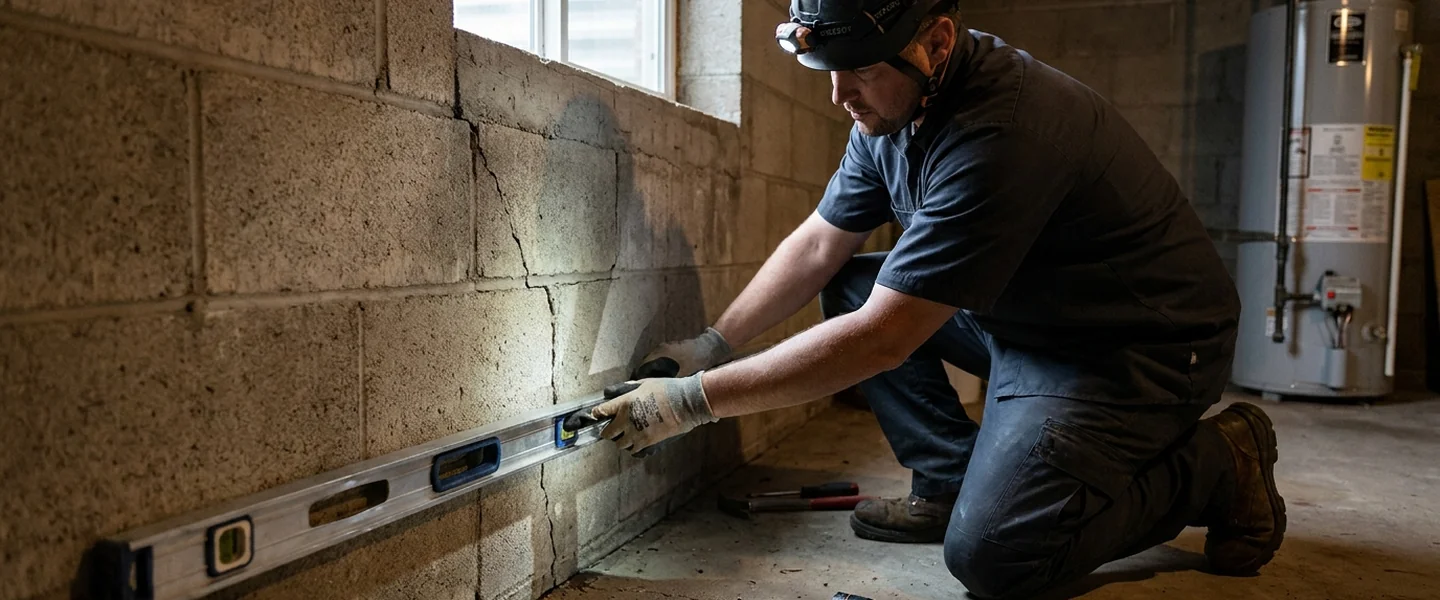
- 1Settlement Mapping — We measure floor elevations at a grid of points throughout the home to map the settlement pattern. Combined with exterior observation of crack patterns and sticking door locations, this tells us which corners have settled and by how much — and how many piers are needed to span the affected section.
- 2Pier Bracket Installation — At each pier location, we excavate a small pit at the base of the foundation (interior or exterior depending on access). A galvanized steel bracket is attached to the existing footing using structural epoxy and through-bolts.
- 3Pier Driving to Refusal — Steel tube sections are hydraulically driven through the bracket and into the soil, section by section, until drive resistance indicates the pier tip has reached bedrock or dense bearing strata. In Adams County, this is typically at 20–35 feet depth.
- 4Synchronized Lift — Once all piers in a section are driven, hydraulic jacks are connected to each bracket simultaneously. Lift is applied in small increments across all piers in coordination, raising the foundation uniformly to minimize stress on the structure.
- 5Lock-Off & Backfill — Pier load is transferred to the bracket with a lock-off pin, hydraulic jacks are removed, and the excavated pits are backfilled and tamped. Interior floor cuts (for interior bracket access) are patched with concrete.
- 6Post-Lift Level Check — We re-measure floor elevations at all grid points and document the achieved lift. This becomes the baseline for the 12-month follow-up level check included in your warranty.
Push Piers vs. Helical Piers — Which Is Right for Your Home?
Push Piers
Best for: full home foundations, heavy load-bearing sections, Adams County's bedrock profile. Driven hydraulically to refusal — the structure's own weight provides the drive force. More reliable in Colorado clay because they reach confirmed bedrock, not just a target depth. Suitable for any soil condition that doesn't have a void or soft zone above refusal depth.
Helical Piers
Best for: porches, sunrooms, additions, decks, and new construction. Also used where the soil profile doesn't have a reliable bedrock layer for push pier refusal, or where weight of the structure is too light to drive a push pier. Screwed in by torque rather than weight — capacity verified by torque measurement during installation.
Adams County Soil Profile
Thornton, Northglenn, Westminster, and Commerce City typically sit on 15–25 feet of expansive clay over sandstone bedrock or dense alluvial gravel. Push piers reach this layer reliably. Brighton and Erie homes near the South Platte alluvial plain have a deeper soft layer — we probe soil and may recommend helical piers with large helix plates for those sites.
Mixed Systems
Some homes need both — push piers on the main foundation and helical piers on a detached porch or lightweight addition. We scope these as a single job with a single mobilization, which is more cost-effective than two separate visits.
Warranty in Detail
Push pier warranty: Lifetime transferable on pier hardware (galvanized steel shaft, bracket, lock-off pin) and installation workmanship. "Lifetime" means for as long as the structure exists on the piers — not a limited term. If the piers move, fail to hold elevation, or the bracket hardware fails, we repair or replace under warranty at no charge.
Helical pier warranty: 25-year transferable on hardware and installation. Helix plates can occasionally torque into a soft void and require a supplemental pier — this is covered under the installation warranty if identified within the first 12 months.
What the warranty does NOT cover: structural damage to the home above the foundation caused by settlement that occurred before pier installation; new settlement in sections of the foundation not covered by piers; damage caused by excavation or construction within 10 feet of pier locations after installation.
Transfer: Both warranties transfer automatically to the next owner with no fees. We provide a pier map (location, depth, and pier type for each pier installed) and the post-lift level measurement record — invaluable documentation for resale disclosures in the Colorado market.
After the Piering Install
30 days: We follow up on door operation (settling doors that were sticking often free up within days of lift) and check that any cracks addressed during the lift haven't re-opened in an unexpected way. Minor crack re-opening during lift is normal and is addressed with injection as part of the scope.
12 months: We return to re-measure floor elevations at the original grid points and compare to the post-lift baseline. Any measurable change triggers a warranty review. The 12-month check is documented and added to your pier record. Most Thornton piering jobs show zero change at 12 months — the piers hold.
House Leveling & Piering FAQ — Thornton, CO
How do I know if my foundation needs piering or just crack repair?
Crack repair addresses sealing; piering addresses the movement causing the cracks. Signs that piering is needed: diagonal cracks wider at the top than the bottom, doors that stick or won't latch, sloping floors measurable with a level, and exterior wall separation from adjacent structures. We make this determination at the free inspection — don't try to diagnose it from the cracks alone.
How much does foundation piering cost in Thornton, CO?
We don't quote over the phone — the cost depends on pier count, pier type, depth to refusal, and access conditions. Call (720) 740-6511 for a free on-site inspection and written itemized quote.
Will my house actually be lifted?
Most Thornton foundations can be lifted 1–3 inches toward original elevation during pier installation. Some structures have been settled long enough that lifting creates stress in finished walls and floors — we discuss realistic lift targets in the written quote and err on the side of stabilization over maximum lift when the structure warrants it.
Will pier installation damage my landscaping?
Exterior pier excavation requires small pits (roughly 3 feet square, 3 feet deep) at each bracket location. We backfill and tamp after installation. Trees, shrubs, and hardscape within 2 feet of pier locations may need temporary relocation — we note this in the written scope before any work begins.
How long does piering take?
Most Adams County pier jobs run 1–3 days depending on pier count and access. We'll give you a day-count estimate in the written quote after the inspection. Most residents remain in the home during the work.
Is the pier warranty really lifetime?
Yes — our push pier hardware warranty covers the piers for as long as the structure exists on them. It's not a limited-year warranty with a cancellation clause. We provide the warranty documentation in writing and it transfers to the next owner automatically.
Will the repair affect my home's resale value?
A properly piered and documented foundation is a selling point, not a liability. Buyers in Colorado's disclosure-conscious market respond better to "piered to bedrock with transferable lifetime warranty" than to an undisclosed settled foundation. Our pier map and level measurement records give you concrete proof that the issue was addressed correctly.
Do I need permits for pier installation in Thornton?
Adams County and the City of Thornton may require a structural permit for foundation piering depending on the scope. We handle permit applications when required and include that in the project timeline. We'll clarify permit requirements in the written quote.
Stop the Settlement. Stabilize for Life.
Free on-site inspection and written quote. Same-week availability in Thornton, Brighton, Commerce City, and Broomfield.
Call (720) 740-6511Related Services
Service Areas
What You Get in Our Quote vs. the Lowball Bid
We don't compete on the lowest sticker price — we compete on the quote that gets the job actually done. Here is what is included in every quote we write, and the cut-corners that show up in cheaper bids.
Included in our written quote
- Engineer-style elevation + crack assessment
- Soil and drainage evaluation
- Written quote with pier counts + warranty terms
- Photo documentation of every crack/movement
- Permit-pulling where required
- Post-install elevation re-check
Cut corners in the lowball bid
- Free-quote with no actual inspection
- Pier-count guesses without measurements
- Subcontracted installation crews
- Warranties that exclude common failure modes
- Pressure to sign at the kitchen table
- Same-day pricing tricks